
Teaching Abroad Is a Career, Not Just an Experience
There's a tendency to frame international teaching as a gap-year-adjacent adventure: something you do for a few years before settling down into a "real" career. This framing undersells what is, for many teachers, one of the most professionally rich trajectories available in education.
International language teachers who approach their overseas career with genuine intentionality, who build skills strategically, seek leadership opportunities, invest in their professional identity, and plan their trajectory, and consistently end up in stronger positions than those who let the years accumulate without direction.
The difference between a teacher with ten years of international experience and a teacher who has done the same year ten times over is intentionality. This article is about how to be the former.
Understanding the International Teaching Career Landscape
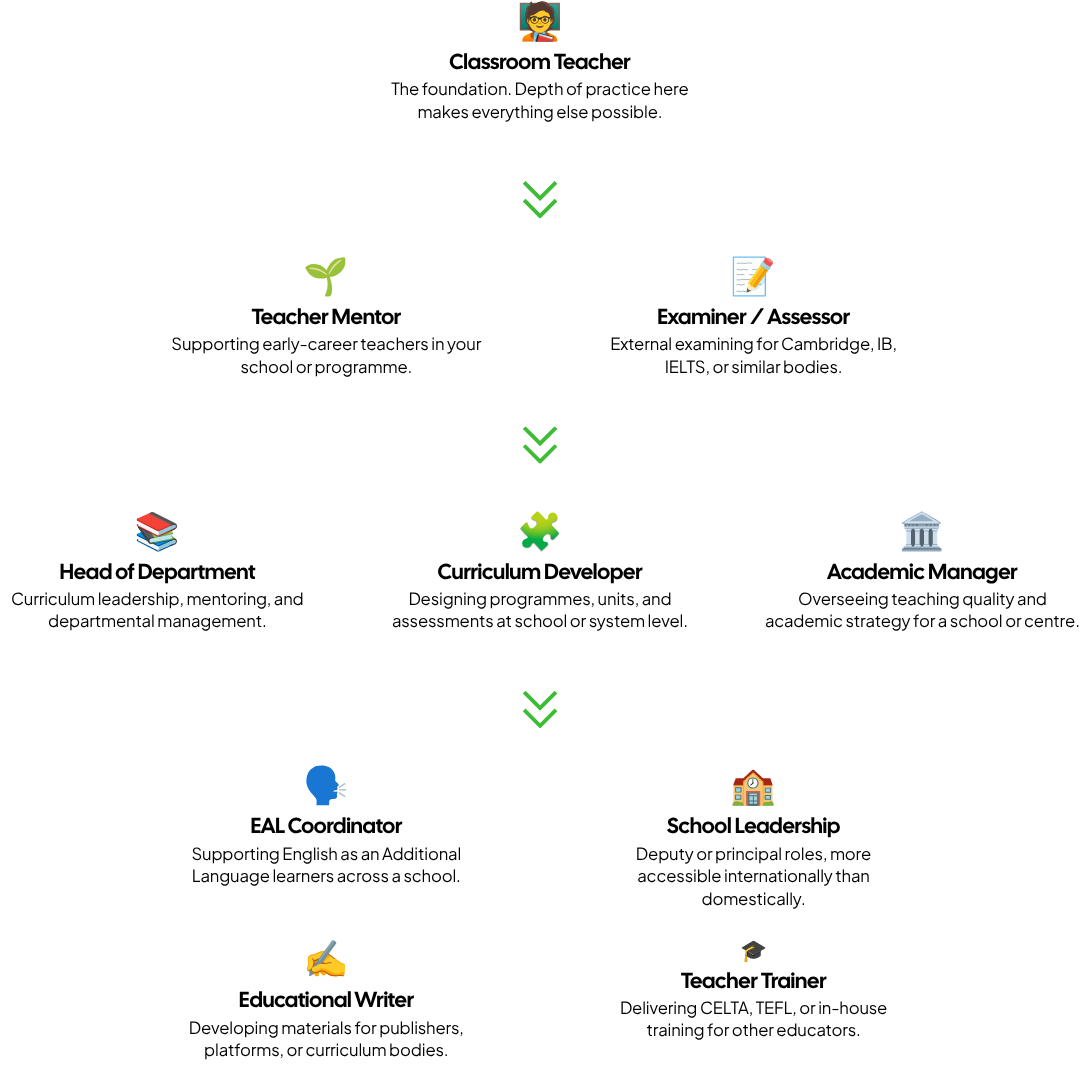
The international language education sector is large, varied, and genuinely meritocratic in ways that domestic education systems sometimes aren't. Strong teachers who build their skills and reputation can move into senior roles, curriculum leadership, teacher training, and school leadership faster in international contexts than many domestic systems allow.
Understanding the landscape helps you navigate it deliberately.
Career Pathways in International Language Education
Building a Professional Profile That Gets Noticed
Your LinkedIn Presence
LinkedIn is the professional platform most used by international school recruiters, and a well-maintained profile significantly increases your visibility to hiring coordinators who are actively searching for candidates, rather than waiting for applications to come in.
- Uses a current, professional headshot (not a holiday photo)
- Has a headline that goes beyond your job title: "EFL Teacher | IB Certified | 8 Years Asia-Pacific" is far more searchable and informative than "Teacher at XYZ International School"
- Contains a detailed summary that reads like a well-written cover letter introduction
- Lists all significant roles with bullet-pointed achievements, not just duties
- Includes your qualifications, certifications, and language proficiencies
- Has recommendations from former principals, colleagues, or students' parents
- Is updated at least annually, ideally whenever something significant changes
Turn on the "Open to Work" feature when you're actively looking. Recruiters use it specifically to filter candidates who are available.
Your Teaching Portfolio
A teaching portfolio, whether digital or physical, is increasingly expected in international school applications and is an outstanding way to differentiate yourself from applicants who can only point to a CV.
- A personal teaching philosophy statement (one page, specific, genuine)
- Sample lesson plans with reflection on outcomes
- Student work samples (appropriately anonymised)
- Evidence of curriculum or programme development you've led
- Photos or video of your classroom practice, where permitted
- Professional development certificates and records
- Any publications, presentations, or external contributions to your field
Platforms like Google Sites, Wix, or a simple PDF document work well. The goal is not a polished marketing website: it's organised, accessible evidence of your professional capability.
Your Professional Reputation
In the relatively small world of international education, reputation matters enormously. International schools talk to each other. Recruiters maintain networks. The teacher who is known as genuinely excellent, collaborative, and professionally generous has access to opportunities that never appear on job boards.
This reputation is built slowly and through consistent behaviour: being the teacher who follows through, who contributes without being asked, who supports colleagues generously, who handles difficult situations with professionalism and grace. It cannot be manufactured quickly, but it compounds significantly over time.
Qualifications That Open Doors
The international language teaching market is increasingly credential-aware. Schools at the premium end of the market, particularly IB World Schools and Cambridge-affiliated institutions, have clear expectations around qualifications and are willing to pay significantly more for teachers who hold them.
Qualifications Worth Pursuing
Strategic Career Moves Worth Making
Seek Leadership Within Your Current Role
You don't need a title to demonstrate leadership capacity. Volunteering to lead a curriculum review, mentoring a newly arrived teacher, organising a professional development session for your department, or coordinating an after-school language club all generate evidence of leadership capability that makes your CV significantly stronger.
Schools promoting from within, or hiring externally for leadership roles, are looking for people who have already demonstrated the behaviour at a level below. Create that track record deliberately.
Move Schools with Purpose, Not Just for Change
Changing schools is a normal and healthy part of an international teaching career. But the pattern of moves matters. Moving from a local language school to an international school is a step forward. Moving from an international school with an IB curriculum to one with a stronger academic reputation is a step forward. Moving laterally, school to school with no discernible progression, starts to raise questions after a few years.
When considering your next move, ask: does this role give me something I don't currently have? A new age group, a senior title, a more prestigious curriculum, a country I haven't taught in, a school culture that will stretch me? If the honest answer is no, it might be worth staying where you are and building depth rather than moving for the sake of novelty.
Choose Your Countries Deliberately
Not all international teaching postings carry the same weight on a CV. Schools in certain cities and countries are more recognisable to future employers and open more doors.
This isn't a reason to only ever apply to elite schools in global cities. But it is worth understanding that a position at a well-regarded international school in Singapore or Hong Kong tends to generate more options for what comes next than an equivalent role at a smaller school in a less prominent market.
That said, personal fit, financial package, lifestyle, and genuine interest in a country are all legitimate factors. A teacher who thrives in their environment and builds real expertise always outcompetes one who is in a prestigious posting but miserable.
Build a Network Outside Your School
Your school is your professional home, but it shouldn't be your entire professional world. Connecting with language teachers across your city, your curriculum network, and your specialisation gives you access to opportunities, ideas, and support that your school cannot provide on its own.
Attend local ELT events and conferences. Join professional associations such as TESOL, IATEFL, or country-specific ELT associations. Connect with teachers at other schools in your city. These relationships often generate both professional opportunities and the kind of intellectual stimulation that keeps teaching interesting over the long term.
Professional Development That Actually Matters
Not all professional development is equal. A one-hour webinar is not the same as a week-long intensive. A conference you attend passively is not the same as one where you present. Being selective about how you invest your professional development time and budget matters, both for your actual growth and for how your portfolio reads.
High-Value Professional Development for Language Teachers
Managing Your Career Across Multiple Countries
A multi-country international teaching career creates specific challenges that domestic teachers don't face. Managing these proactively protects both your professional record and your financial future.
The Long Game
The most successful international language teaching careers are built on a combination of genuine craft, strategic positioning, professional generosity, and patient consistency.
Genuine craft means being a teacher who keeps getting better: who reflects on practice, who reads widely, who knows their subject deeply, who genuinely cares about student outcomes. This is the foundation. Nothing else compensates for its absence.
Strategic positioning means making deliberate choices about roles, schools, qualifications, and locations that open doors rather than closing them.
Professional generosity means contributing to your school and your field beyond what is required, not out of self-promotion but because generosity is how professional reputations are built.
Patient consistency means showing up, day after day, with professionalism and commitment, and trusting that this compounds over time in ways that are hard to see in the short term but very visible in the long term.
International teaching is one of the most genuinely rewarding careers available to educators. Approach it with the same intentionality you bring to your classroom, and it will give back in kind.
Career Consultation: Want help putting together your career plan?
Our team can review your profile, talk through your options, and help you map out your next move — completely free.
Related Guides

CV Writing Tips
Expert advice on crafting a standout CV for language education roles, covering layout, key sections, and tailoring for international schools.
Read more
Recording Your Video Introduction
Create a concise, professional introduction video and add a private viewable link to your candidate profile.
Read more
Interview Preparation
How to prepare for video and in-person interviews with international schools, covering common questions, demo lessons, and what to ask.
Read more